I have spent the past year having a lot of conversations with law students about AI. Most of them do not start with rules or policies. They start with a more basic concern: is this actually helping me learn, or is it just making things feel easier?
That question matters more than it first appears. AI systems are very good at producing answers that sound clear, confident, and complete. Sometimes that is genuinely helpful. Other times it creates a subtle problem. The work looks finished before the thinking is finished. In law, where judgment is the product, that gap matters.
Law school is not primarily about accumulating information. It is about learning how to evaluate claims, test reasoning, verify authority, and decide when something is reliable enough to use. AI changes the workflow around that learning, but it does not change responsibility. If anything, it raises the stakes, because it becomes easier to accept an answer without doing the work that builds judgment.
I wrote AI Literacy for Law Students: Using AI While Building Legal Judgment for my own students first. It reflects how I expect students in my classes to use AI while they are still learning how to think like lawyers. It is not a tool manual and it is not anti‑AI. It is an attempt to be honest about what these systems do well, where they fail quietly, and how easy it is to confuse fluency with understanding.
This guide is about using AI during law school without displacing the learning that law school is designed to produce.
What This Guide Focuses On
Rather than walking through specific tools, the guide focuses on habits and judgment. Here are some of the things covered in the guide:
- What AI is actually doing when it helps. The guide explains, in plain language, how large language models generate output by predicting text rather than reasoning from facts, and why that matters for legal analysis. For technical background, see Attention Is All You Need by Vaswani et al.
- Why confident answers can still be wrong. The guide explains hallucinations and why models can produce answers that are mostly right but slightly off in ways that matter. OpenAI’s own explanation is a good starting point.
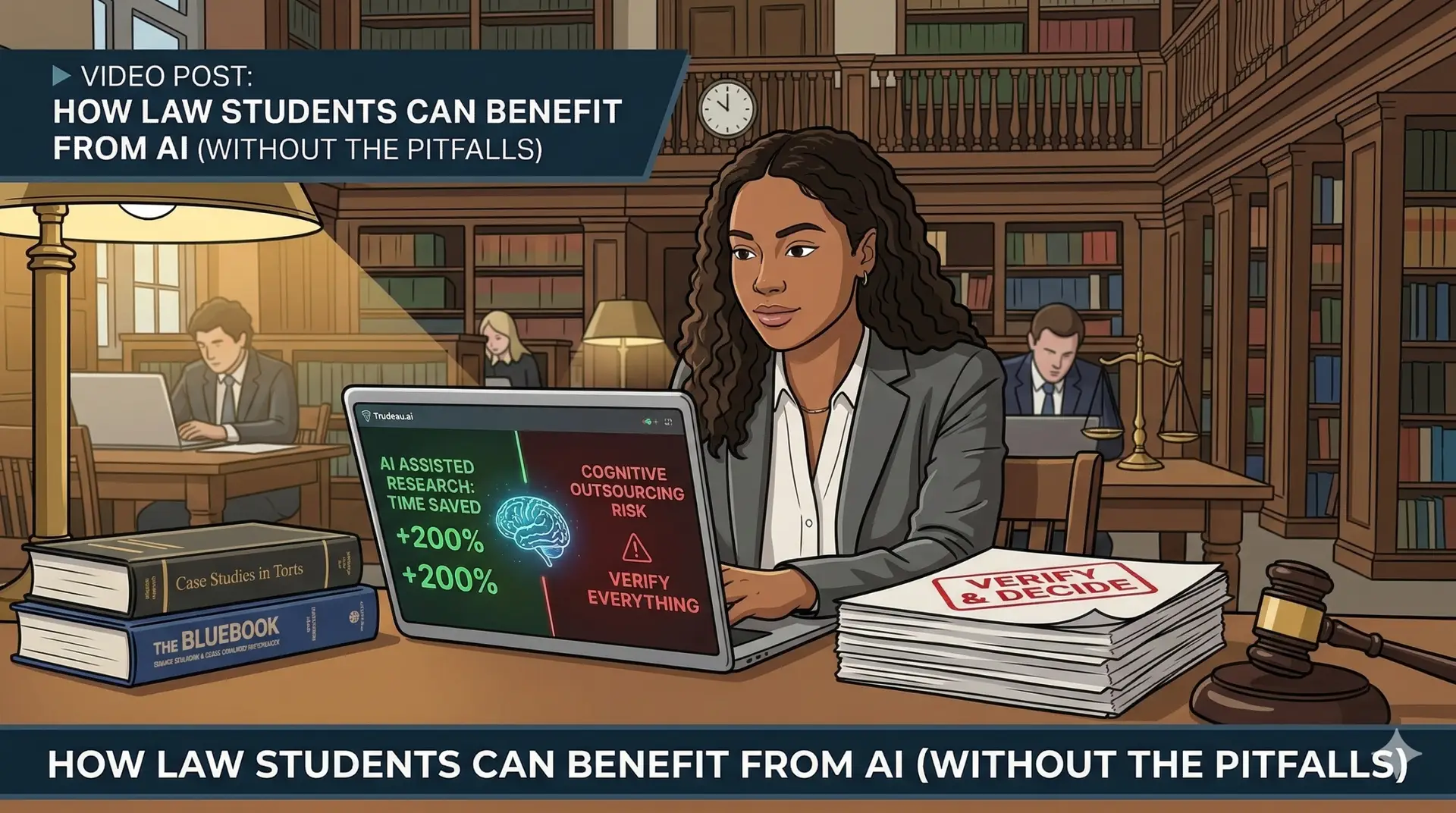
- The risk of cognitive outsourcing. When tools make hard tasks feel easy, learning can quietly suffer. The guide discusses recent research on AI‑assisted writing and learning, including an MIT‑affiliated study examining brain connectivity, ownership, and recall in AI‑assisted writing tasks.
- Verification as a learning habit. Verification is framed not just as self‑protection, but as one of the fastest ways to learn. The guide connects this to real consequences in practice, including documented court sanctions involving AI‑generated hallucinations, collected by Damien Charlotin.
- Creating a judgment workflow. The guide offers a repeatable process for using AI responsibly: generate, pause, verify, and decide. The goal is to slow things down just enough to keep the human in control.
- Developing Professional Judgment. The guide ties student habits to professional identity, emphasizing that responsibility never shifts to the tool. It draws on ABA guidance requiring independent review and verification of AI output (ABA Formal Opinion 512)
Who This Is For
This guide is written for law students, but it is also meant to be useful for faculty, clinicians, and supervisors who are trying to set clear, reasonable expectations around AI use. It is not a universal policy. Rules vary by school, course, and instructor. This reflects one approach grounded in a simple idea: judgment is something law students are actively building, not something they can afford to hand off to AI tools.
If you teach or supervise students, please share it or adapt it. If you disagree with parts of it, that is fine. Let me know what I should add, delete, or clarify for the next version. This is Version 1, written in public, because the conversation about AI, learning, and professional judgment is still unfolding.