Why I Started Thinking About This at All
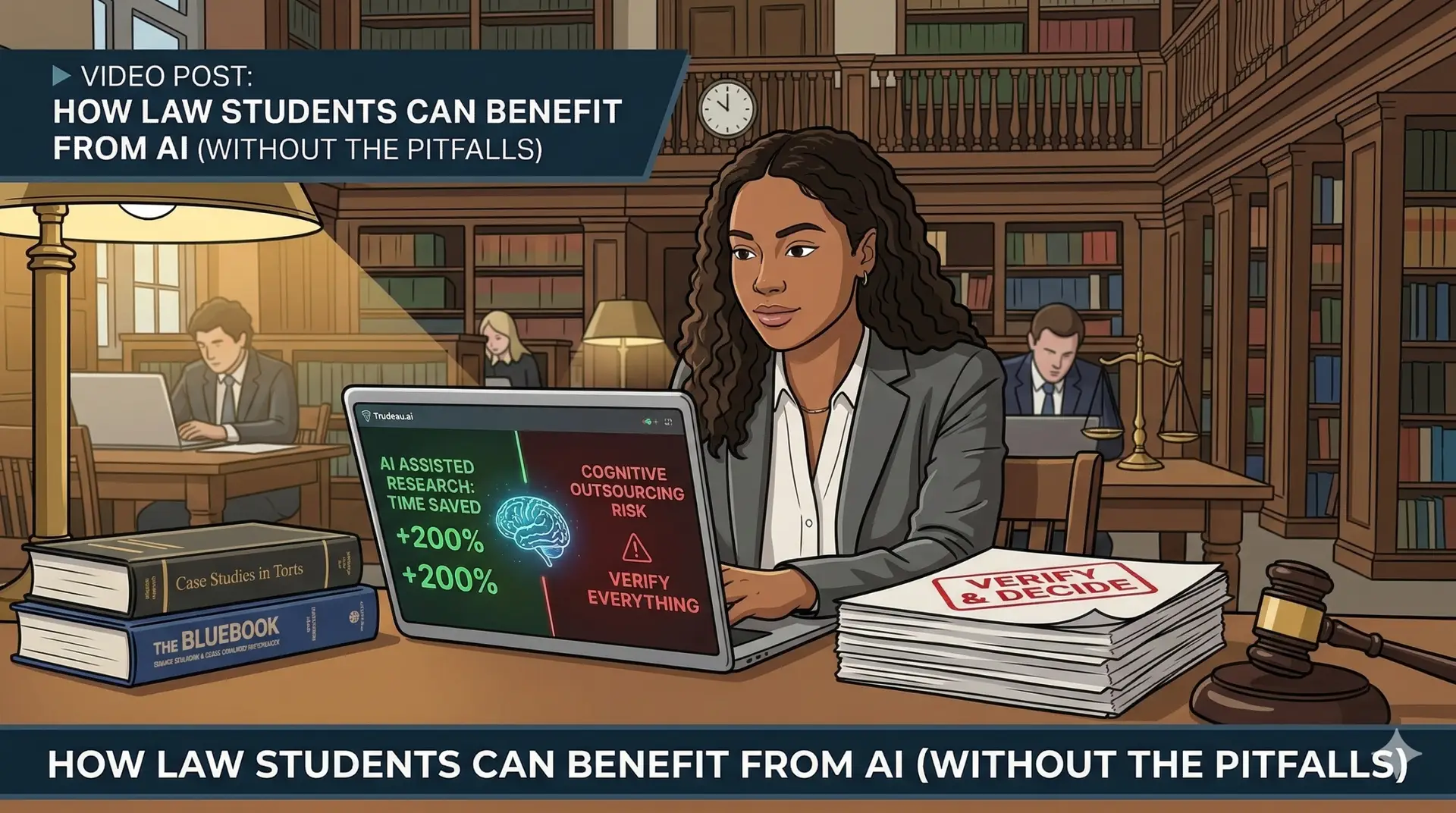
This Fall 2025 semester, I developed and deployed an CustomGPT Ai Property Tutor for my first-year Property Law course. I did this to solve a teaching problem that has followed me for most of my career. My first-year law students generally do what I ask of them. They read the cases. They brief them. They outline after class. They show up prepared. On the surface, it looks like learning is happening. And some of it is. But every year, the same moment arrives, usually on the first exam, where students discover that what feels like understanding is really just recognition. They can spot a rule when it appears on the page, but once the facts change, they struggle to apply the rules.
For 1Ls at least, this is not a motivation problem. It is a learning problem. Recognition feels good and productive. But transfer of deep understanding is much harder.
At the same time, another reality has become impossible to ignore. Students already use AI as part of how they study. Not because teachers require it. But because the tools exist and have quickly become part of everyday life. Surveys confirm what most professors now sense intuitively: a large percentage of college and graduate students use tools like ChatGPT to help them study and review material. A recent Pew Research Center report documents how widespread this already is.
Sometimes AI helps. It can restate a concept or summarize a passage. But many times, especially for students who are new to law, it complicates things. Generative AI is very good at producing answers that sound confident and complete, even when the underlying reasoning is shaky or wrong. For a novice learner, that confidence is seductive. It creates the feeling of understanding without the work that real understanding requires.
Pretending this is not happening does not make it go away. It just means that I have no role in shaping how it happens. So I decided to shift how I think about the problem.
If students are already turning to AI, the real question is not whether to allow it or ban it. The question was whether I could take control of the narrative and give them something better. Something designed intentionally for learning rather than to just give answers. Something built around my course, my materials, and my expectations. Something that reflects how I actually teach, rather than how a general-purpose system (like ChatGPT) guesses a law school class might work.
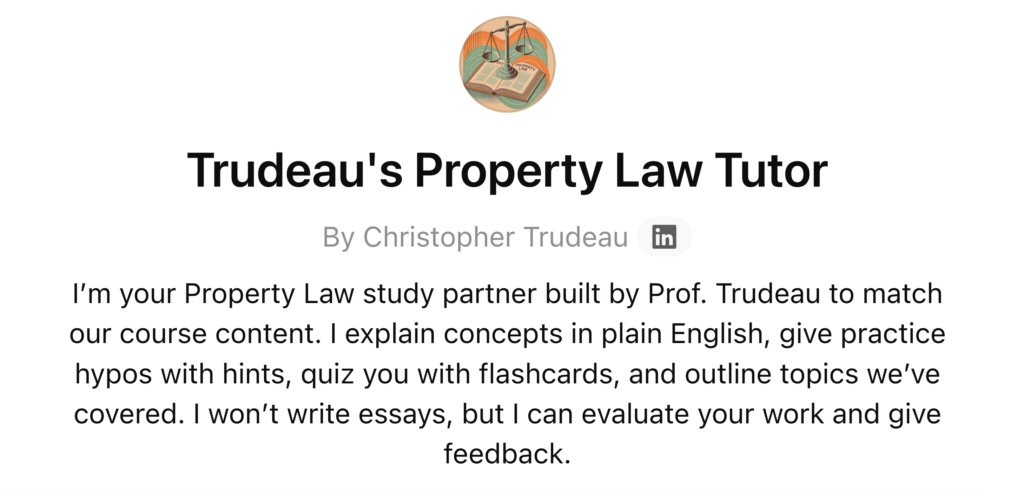
Enter the AI Property tutor, which you can try out here. I did not create it to be cutting edge (though I did like teaching myself how to build one), but I did it as a way to reclaim a core part of teaching in a world where AI is part of everyday life.
What I Mean When I Say “AI Tutor”
When I talk about an AI tutor, I am not talking about a general purpose chatbot that students prod with vague questions and hope for the best. I am talking about a course- aligned study tool that is intentionally designed to help students practice the kind of thinking I am trying to teach. In my case, that meant grounding the tool in my own course materials and my own way of explaining concepts. The goal was not novelty or automation. The goal was repetition, feedback, and structure.
Anyone who has worked with a good human tutor recognizes the pattern. A good tutor does not simply deliver information and move on. A good tutor explains a concept in plain language, checks whether the student actually understands, asks follow-up questions, and offers a hint when the student is stuck instead of immediately handing over the answer. That dynamic is what I tried to recreate. In its simplest form, an AI tutor is a structured way to use AI to support active learning through practice and repetition rather than as a tool to deliver finished answers.
What I Was Not Willing to Build
That distinction matters, because skepticism about AI in education is well earned. We have all seen what happens when students treat AI as a shortcut. The work looks cleaner, faster, and more confident. But something important goes missing in the process. Recent research from MIT makes this concern harder to ignore. In a study examining brain activity when people rely on large language models to think for them, researchers found reduced cognitive engagement during the task itself, along with weaker recall and understanding afterward. In plain terms, when the model does the thinking, the brain does less of it.
The project, Your Brain on ChatGPT, raises a question educators cannot dodge. If students outsource too much reasoning too early, they may feel more productive while actually learning less. You can read the MIT Media Lab’s overview of that research here.
From the beginning, I was clear about what I was not trying to build. I would not deploy an AI Tutor that served as a replacement for my teaching. And it could not be a paper writer or an answer key. If an AI tool simply hands students completed work, it undermines learning. The entire point of a tutor, whether human or artificial, is to create more opportunities for students to do the learning themselves.
Why This Fits with What We Already Know About Learning
My decision to try this did not come out of thin air. Long before generative AI entered the classroom conversation, research has consistently showed that students learn more when they actively engage with material instead of passively absorbing it. One of the most cited examples is the large meta analysis published in the Proceedings of the National Academy of Sciences showing higher exam scores and lower failure rates when active learning replaces traditional lecture across STEM disciplines. Of course, you don’t need a meta analysis to see this play out, but it helps to know that the intuition is backed by evidence. Learning is built through use, not exposure.
The problem, of course, is scale. I can run in class exercises, assign practice, and hold office hours, but that only goes so far. Students still need more chances to try, fail, adjust, and try again. What finally convinced me to experiment with an AI tutor was that I finally realized how much availability matters. A tutor that is available whenever the students study, not just when my calendar allows, changes how often they practice and lessens the barriers to learning.
What Changed for Students
The most immediate change was volume. Students practiced more, and they practiced earlier. Not because they were required to, but because the barrier was lower. They could test themselves late at night, on weekends, or in short bursts between other commitments. They also received feedback faster. The best time to correct a misunderstanding is right after it forms. The AI tutor provided that correction.
Deeper insight: Right now you are thinking: What if AI provided the wrong answer? That happened. It wasn’t always correct, especially for really nuanced things where subtle wording changed the answer. But it was correct the vast majority of the time since I trained it on my material (if I had to guess, I would say it was correct 95% or more.)
There is solid research explaining why this kind of practice matters. Retrieval practice, the act of pulling information from memory, strengthens learning far more than rereading notes. A paper by Roediger and Karpicke lays this out nicely, if you want to learn more. The AI tutor was designed to push students to retrieve and apply knowledge rather than simply recognize it. Because of that, during class time, I noticed improved recognition of the material we were covering and how students explained ideas when responding to my questioning. Being prompted by the AI tutor to articulate a rule or walk through reasoning exposed gaps they did not know they had. Research on learning by teaching and self explanation supports this effect, which is what I tried to recreate with the AI Tutor.
What Changed for Me
From my side of the desk, several things shifted as well. Office hours changed tone. Instead of repeating the same foundational explanations, conversations moved more quickly to application and nuance. Student questions improved. They were more specific and more grounded. Students had already tested their understanding and arrived knowing where they were confused. But the most important thing for me was that I had a way to guide AI use instead of pretending it was not happening. Blanket bans tend to push use underground. Guidance brings it into the open and lets you shape how students engage with the tool.
Why This Is Still an Experiment
I do not treat the AI tutor as infallible. It makes mistakes. It sometimes over explains. It occasionally misses nuance. In that sense, it behaves a lot like a new teaching assistant. The value is not perfection. The value is structured practice and feedback. I supervise it, test it, and refine it. When it goes off track, that often reveals ambiguity in my own materials or explanations, which has been an unexpected but welcome benefit.
If You Want to Build One Yourself
If you are an educator wondering whether this is worth exploring, my advice is simple. Do not start by asking what the technology can do. Start by asking where your students need more practice than you can realistically provide. That gap is where an AI tutor can help.
I wrote a separate guide for educators who want to explore this approach themselves. Not as a pitch for AI, and not as a technical manual, but as a practical walkthrough of the decisions that actually matter. The guide explains how I designed the tutor, how I trained it on my own materials, where it helped, where it failed, and what I would change if I were starting again.
If you are considering building something similar, or if you are simply trying to think more clearly about how AI fits into your teaching without undermining learning, the guide is meant to save you time and a few wrong turns.
You can download it by clicking the link below