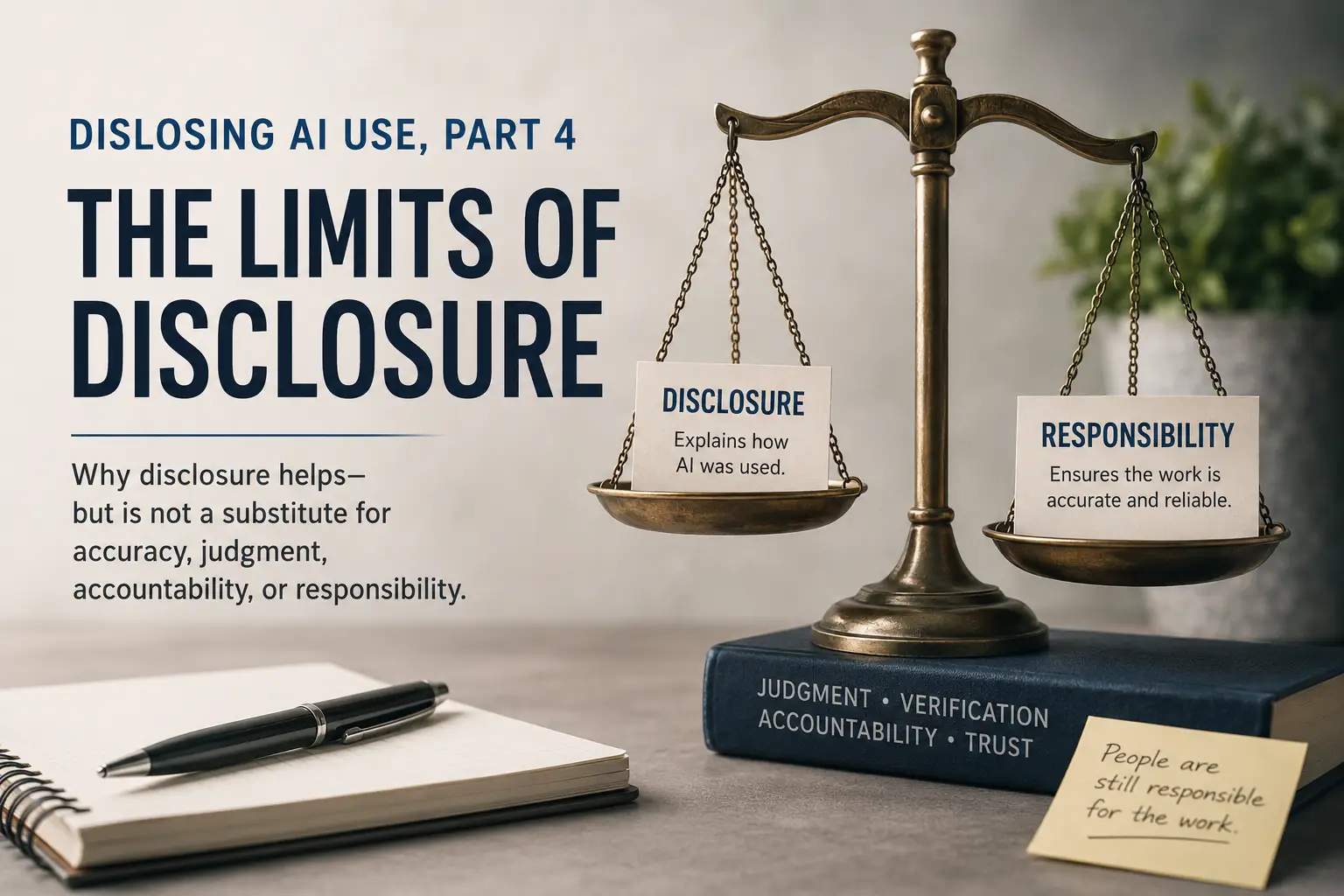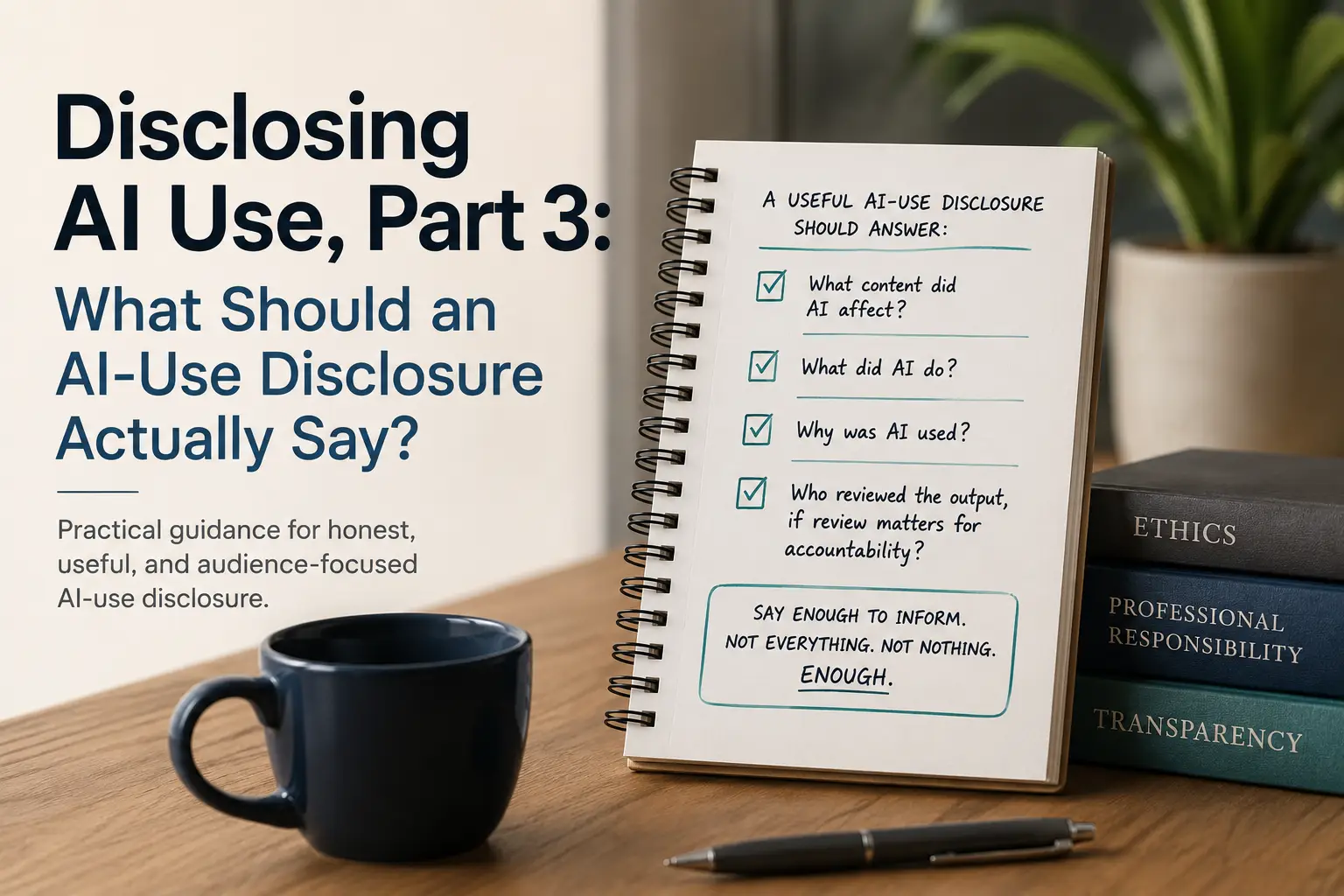
Last week, I facilitated a roundtable on AI and health literacy. The roundtable’s allocated time was almost exclusively taken up by the topic of AI-use disclosure. I didn’t plan it that way; it was just what the attendees were passionate about. In that roundtable, we debated whether, when, and how professionals should disclose when they use AI to create, revise, or support professional communication. This is a loaded issue, so I decided to write a blog series on the different angles to this seemingly simple issue.
In the roundtable, some participants took a hard line: that AI use should always be disclosed. The thinking goes – if AI helped create something, the audience has a right to know. I totally understand that position. Transparency isn’t just an abstract ideal; it matters deeply when someone relies on your words to navigate a medical issue, a financial choice, or a legal battle. We shouldn’t lead people to believe a human entirely created a document if AI shaped its substance. But a mandatory disclosure of AI use has many pragmatic problems, so I advocate for a middle ground, as I’ll explore more in this blog series.
What does “using AI” actually mean?
The phrase sounds straightforward until you start to deeply think about it. Using AI can mean brainstorming titles, outlining a draft, or sharpening a clunky sentence. But it can also mean drafting a patient handout from scratch, summarizing massive research papers, or generating a legal analysis. Sometimes it means creating synthetic images, videos, or voices that look and sound completely real. In my view, treating a digital brainstorming partner the exact same way as an automated ghostwriter doesn’t make us more transparent, and it arguably doesn’t impact trust, veracity, or authoritativeness. Rather, it just makes disclosures less likely to be read because they would become so ubiquitous that people would just overlook them.
Regulators are already struggling with this problem. Look at the European Commission’s recent draft guidelines under the EU AI Act. The EU is trying to sketch out these boundaries by giving a pass to basic assistive tools like spellcheck or grammar edits, but they want to force people to disclose when AI actually writes the core substance. That seems like the right path.
My point is this: trying to pin down a single, rigid rule for a fast-moving, creative process can quickly turn into an administrative nightmare.
What do we mean by “disclosure”?
The word “disclosure” itself causes problems. What are we actually asking people to do? Slap on a one-sentence disclaimer? Hand over a complete software inventory? Print out the exact prompts and outputs?
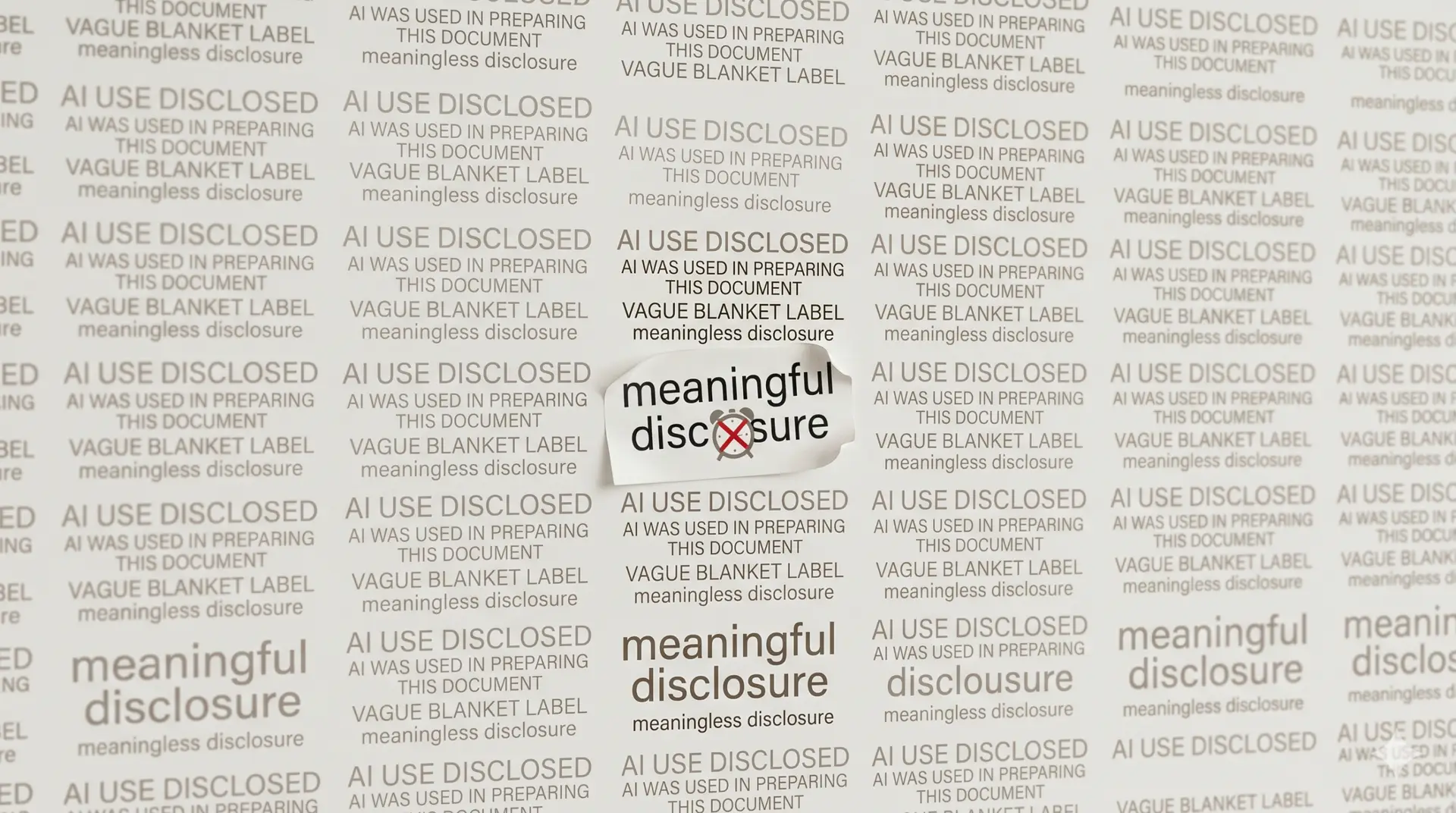
If we force professionals to log every brainstorm, tweak, prompt revision, and human verification step, the disclosure will end up longer than the actual document. On the flip side, a vague blanket phrase like “AI was used to prepare these materials” tells the reader absolutely nothing. It covers up what the AI did, how much it mattered, and whether a human even bothered to double-check the work.
The Risks of Too Many Disclosures
The other problem with a rigid, one-size-fits-all rule, is based on behavioral science. It demands too much disclosure for low-risk tasks, which teaches people to tune out. Or it could also do the opposite and provide too little for high-stakes situations, giving readers a useless label instead of the context they actually need.
We already experience this in everyday life. Cookie banners and privacy policies surround us, and we almost always click “agree” just to clear our screens—I do it all the time, myself. A Pew Research Center survey showed that 56 percent of Americans routinely click “agree” without reading a single word of a privacy policy. To most people, those policies are just speed bumps to ignore, not helpful guides that aid understanding and consent.
Researchers at Carnegie Mellon’s CyLab have proven just how quickly users dismiss cookie consent walls. In short, cookie consents are a textbook case of what NIST calls “security fatigue”—the mental exhaustion that sets in when tech constantly forces us to evaluate low-level risks, driving us to make lazier, riskier choices. My concern is that if we turn AI disclosure into just another automatic pop-up, then we are missing the point. We won’t build trust; we will just be wasting time and effort.
To be sure, I am not suggesting we bury our heads in the sand and stop disclosing. That approach is just too limited for the AI world we are dealing with now. AI changes the game for authorship, expertise, and trust. It can help us communicate clearly, but it can also spit out incredibly polished, authoritative nonsense. It blurs reality with digitally created information. To me, the real danger is that AI tempts professionals to outsource their professional judgement. This feeds right into automation bias—our hardwired tendency to trust automated systems as objective truth, which turns an expert into a glorified rubber stamp.
Shifting the Question from Presence of Disclosure to Impact of Disclosure
Disclosure has to mean something. Instead of treating it like a binary checkbox—“Was AI used?”—we need to ask a better question:
“Would knowing about the AI help the audience understand or trust the work?”
That shift forces us to look at context, risk, and ultimate accountability. Yes, it’s the classic legal cliché: “it depends.” But the easy answer is flat-out wrong here. To move past the cliché, we need a practical, risk-based framework: something that separates minor assistance from substantive generation, which I am going to map out later in this series.
The goal, in my view, is to move past performative compliance and focus on meaningful disclosure. If AI shaped the core substance or drove a high-stakes decision, say so clearly. If you just used it to bounce ideas around or polish a paragraph that you fully reviewed and own, a label adds little value. We are still early enough to build healthy professional norms before bad habits set in. So let’s stop pretending that “I used AI” answers the question. It only starts it.
AI-Use Disclosure: I used Claude, ChatGPT, and Gemini to help me with this article. I used Claude and Chatgpt to help me brainstorm about this article and create and refine a general outline. I used Gemini (using AI search in Google) to find resources to cite for this article, which I then vetted for accuracy. I also used Gemini to create the cover photo for this post. I also used Claude to help with some initial writing to help add meat on the bone for my own thoughts of what I wanted to say. And then I edited it extensively to make sure it said what I wanted it to say and still sounded like me. Also, I used Elementor’s AI feature to help upload the draft of the article into a blog post. If I were fully disclosing AI use, I would put the umpteen prompts I used in this disclosure, but that would make this disclosure longer than the article.