For most law students and lawyers, AI is a paradox right now.
On one hand, a Harvard study shows that well-designed AI tutors can more than double your learning gains compared to a traditional classroom. On the other, if you use AI poorly, you can face career-ending consequences before you even pass the bar.
I’ve seen the data, and the speed is staggering. In a well-written article by a Judge Xavier Rodriguez, the Judge did a small experiment comparing an intern’s work to an AI’s. The intern took hours to summarize one witness; the AI took seconds to summarize multiple witnesses across trial and deposition records. It’s tempting to look at that and think you’ve found a superpower. But that speed comes with a massive risk if you don’t manage it correctly.
Hidden Dangers: Cognitive Outsourcing & Confidentiality
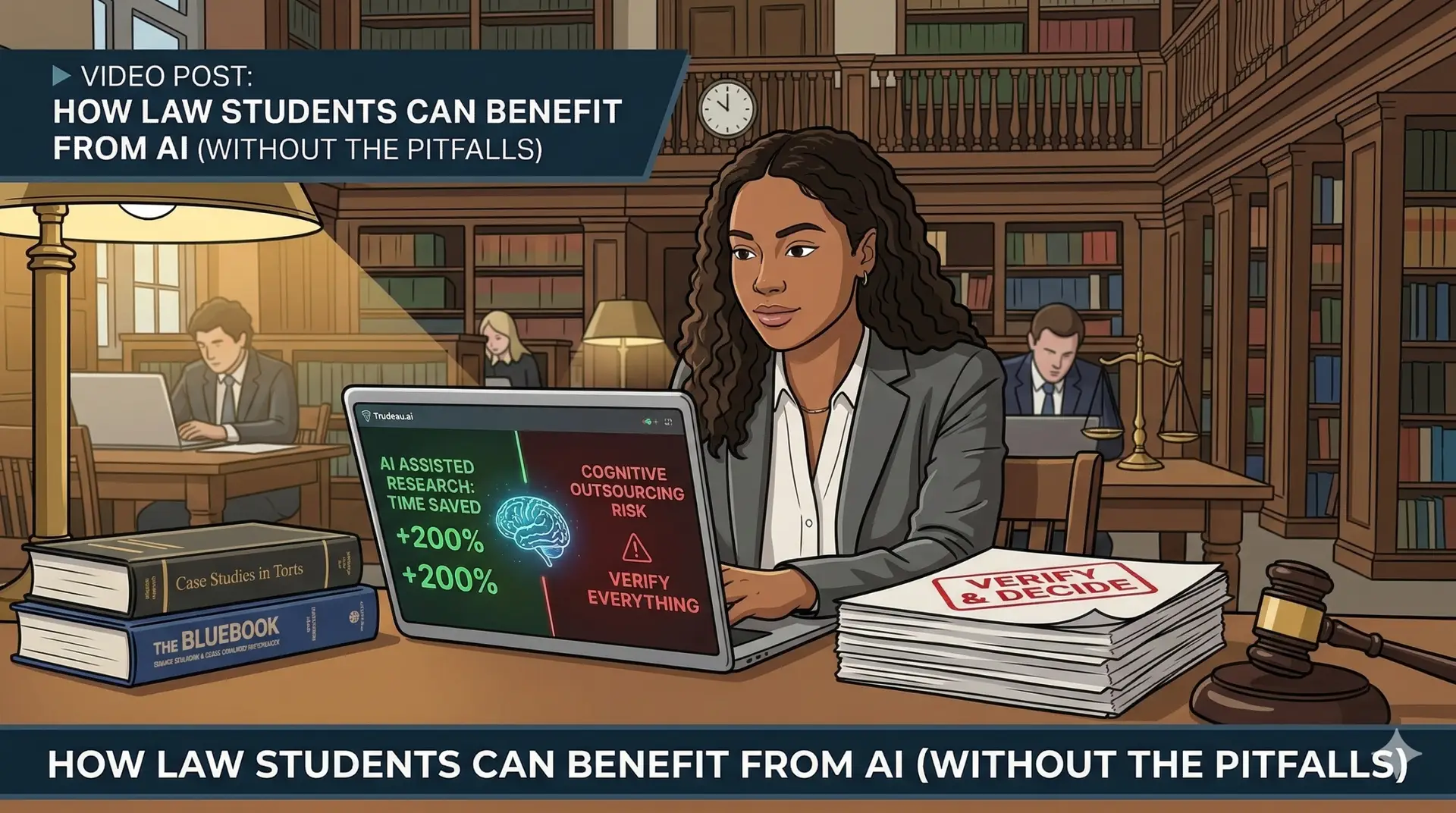
The real threat isn’t just a “hallucination” where the AI makes up a fake case citation. It is what is called cognitive outsourcing. When you hand off difficult mental tasks to an AI tool, you stop the deep thinking required for actual learning. You stop building your own judgment. And because AI outputs sound so confident and well-structured, we fall victim to “automation bias,” which is the tendency to assume the machine is right. This leads us to overlook subtle errors that can torpedo a legal argument.
Plus, you have to remember that your conversations with large-language models, like ChatGPT, may not be protected by attorney-client privilege. If you put sensitive client details into a prompt, that data is no longer confidential. There is even a recent opinion that applied that same principle to clients who use ChatGPT to prepare for meetings with their lawyer.
Build Your AI Workflow
You can’t ignore these AI tools, but you can’t dive in blindly either. Use this four-step process to ensure AI stays an assistant, not a boss:
- Generate: Use the AI to create your first draft, outline, or summary. It’s a starting point, not a finish line.
- Pause: Stop and consciously recognize that the output is raw material. It is a “hallucination machine” until you prove otherwise.
- Verify: Roll up your sleeves and check every fact and citation against original, reliable sources. This is where the real legal work happens.
- Decide: Use your own professional judgment to edit, rewrite, and own the final work.
The Bottom Line
The American Bar Association made it clear in Formal Opinion 512: you have a professional duty to supervise this technology. Checking the AI’s work isn’t just a chore; it’s how you build your own expertise. The technology is an incredible assistant, but it’s a terrible boss. Don’t let an AI tool make you a weaker lawyer. Use it to become a more effective professional while keeping the final responsibility where it belongs.