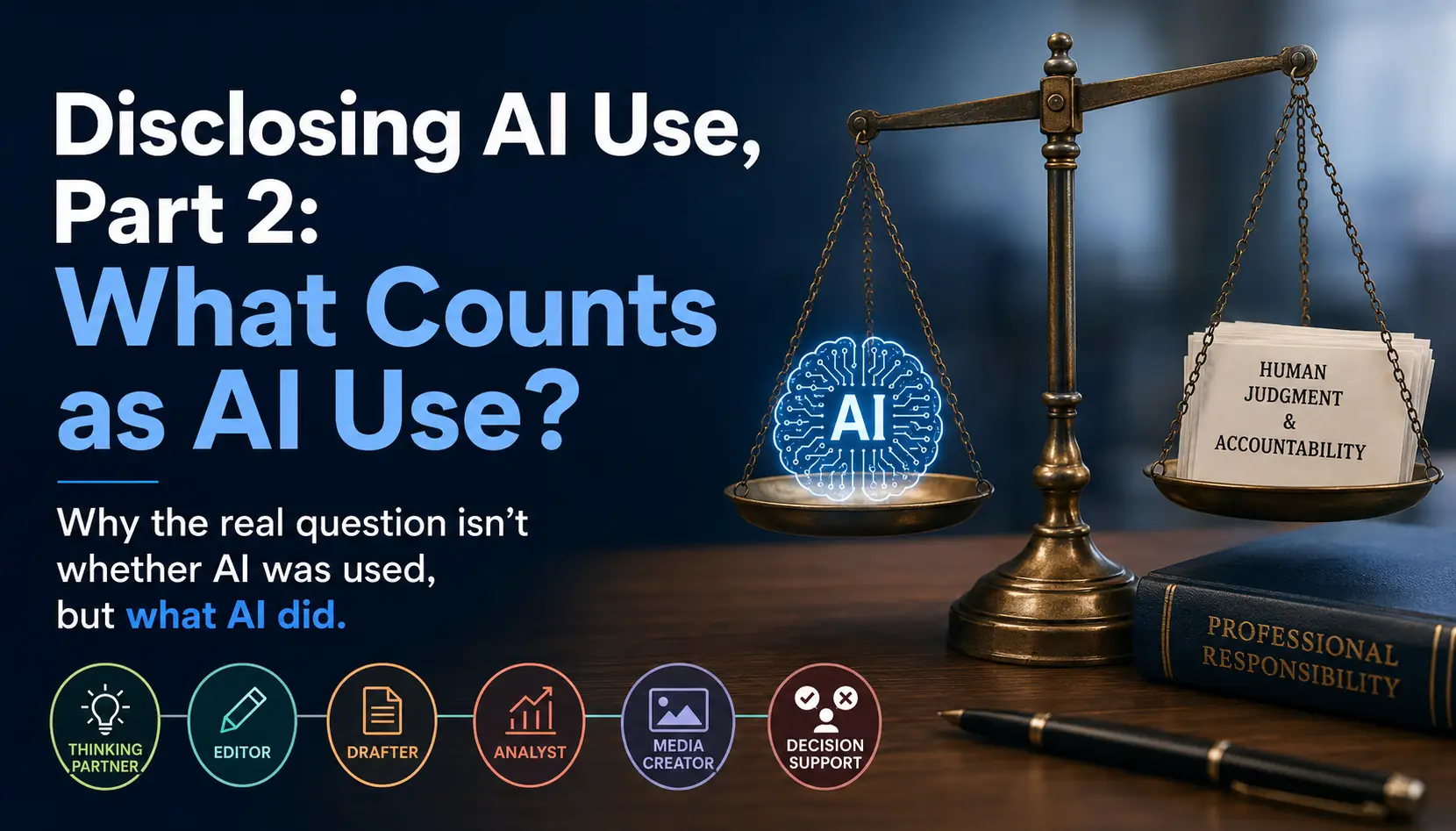
In Part 1 of this series, I argued that saying “I used AI” often does not tell people enough. It may sound transparent, but it leaves the audience guessing about what AI actually did. In Part 2, I turned to the next problem: AI use is not one thing. Using AI to brainstorm is different from using it to edit, draft, analyze, create media, or help make decisions.
That brings us to the next, more practical question: if disclosure is sometimes needed, what should the disclosure actually say?
I tend to call these “AI-Use Disclosures.” That phrase is a little clunky, and I’m not married to it, but I like it because it focuses on the use, not just the tool. The term “Disclosure” could mean anything from a user’s point of view, so I think the term “AI” needs to be in there. Anyhow, the point is not to just announce that artificial intelligence was used; instead, it is to explain what role it played in developing the work.
This is where things gets a little murky. People talk about AI disclosure as if it means adding a simple label, like “AI was used” or “Created with AI.” Those statements may be true, but they do not tell the audience whether AI helped with the wording, the research, the analysis, the image, the recommendation, or the decision.
The Problem With Vague Disclosure
A vague AI-use disclosure is better than outright deception, but not by much. If I read a patient handout that says, “AI was used in preparing this material,” I still do not know whether AI fixed grammar, drafted the whole handout, summarized medical research, or generated treatment guidance that a clinician reviewed later.
The same problem arises in legal, educational, journalistic, and organizational writing. “AI was used” may hide the most important facts that readers need to know. It might mean a lawyer used AI to organize a first draft but checked every case and revised the letter line by line. It might mean a student asked AI to brainstorm possible counterarguments. It might mean a nonprofit used AI to generate a donor appeal. Or it might mean someone accepted an AI-generated explanation of a complicated issue with only a quick skim before publishing it.
That is why some professional and publishing organizations have moved toward more detailed disclosure requirements. The International Committee of Medical Journal Editors says authors who use AI-assisted technologies should disclose that use and describe how they used the technology. Elsevier’s policy similarly requires authors to disclose AI use in manuscript preparation and to explain the tool, the purpose, and the author’s role in reviewing the work. The useful information is how AI was involved in creating the work.
The Problem With Over-Disclosure
The other side of the problem that bothers me is that more detail is not always better. In Part 1 of this series, I explained my concern that AI-use disclosure could become another notice people learn to ignore. We already live in a world full of privacy policies, cookie banners, consent forms, and fine print. Some of those notices serve a purpose, yet most have become background noise. They may create the appearance of transparency without helping people understand much of anything.
In my view, over disclosure creates similar risks. If disclosure means listing every AI tool, every prompt, every output, every revision, every rejected suggestion, and every verification step, then the disclosure can quickly become longer than the work itself. That may give the appearance of rigor, but a long disclosure may be technically transparent but practically useless.
This is where I worry that AI-use disclosure can start to look like the worst parts of privacy policies or informed consent forms. We cannot just give people more words and call that transparency because words are not the same thing as understanding. In my classes and trainings on clear legal drafting, I always say that more words just give the institution a paper trail and the reader a headache.
So I don’t think the goal should be to disclose everything that happened behind the curtain. The goal should be to disclose the parts that help the audience assess the impact of AI on the final product.
That means the right disclosure depends on context. This was the main point of Part 2 of this series, where I argued that AI use sits on a spectrum. Using AI as a brainstorming partner is not the same as using AI to draft, analyze, create media, or support a decision. A scholarly journal may reasonably require authors to identify the AI tool and explain how they used it. A court may require lawyers to certify that they verified legal authorities under Federal Rules of Civil Procedure Rule 11 or similar rules. A newsroom may require clear labels for AI-generated images that could be mistaken for real events. The Associated Press standards on generative AI take that last concern seriously, especially when AI-generated or altered images could falsely depict reality.
In any case, my point is that not all uses should get the same disclosure.
A Useful Disclosure Should Answer a Few Basic Questions
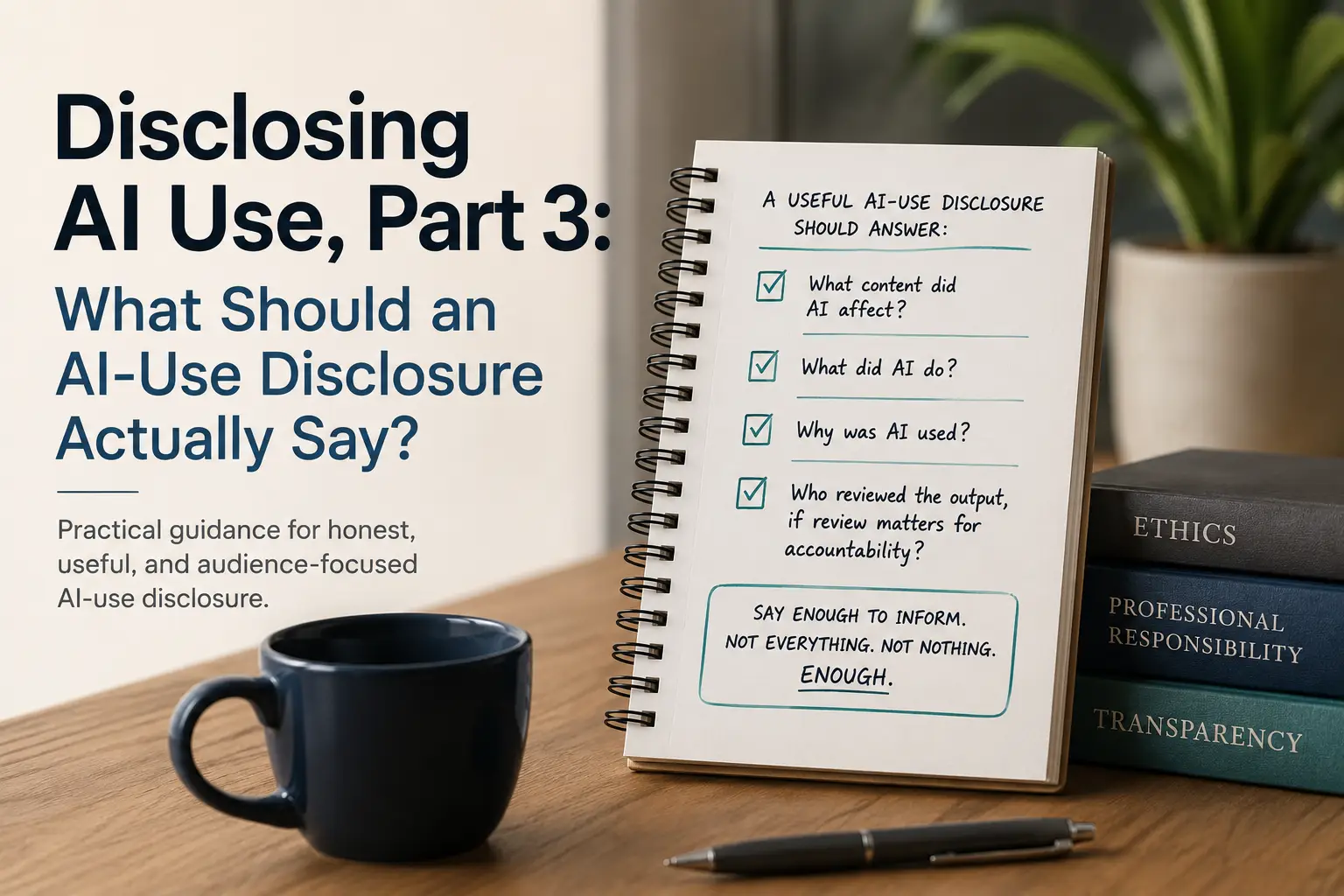
An effective AI-Use Disclosure does not need to become a confession, a technical appendix, or a prompt diary. But it should answer the questions a reasonable audience would care about:
- What content did AI impact? Did AI affect the whole document, a summary, an image, a chart, a translation, a headline, or a recommendation? The answer can change how much the audience needs to know. Readers may care much more if AI shaped the final advice than if it helped brainstorm a title.
- What did AI do? Did it draft, revise, summarize, translate, simplify, generate media, analyze facts, or support a decision? This is the heart of the disclosure. Without this information, “AI was used” does not give the reader much to work with.
- Why was AI used? Purpose can change how people understand the use. AI used to improve readability after human writing and review is different from AI used to generate the content itself.
- Who reviewed the output, if review matters for accountability? This will not matter in every case. If AI helped brainstorm a title or revise a sentence, the audience probably does not need a mini-org chart of who looked at it. But when AI was used for analysis, recommendations, or decision support, the disclosure should usually say something about human review. As I discussed in Part 2, those uses raise different concerns because AI is doing work closer to human judgment. If AI helped prepare a patient handout, did a clinician review it? If AI helped draft legal analysis, did a lawyer verify the authorities and reasoning? If AI helped make or support a decision, who remained accountable for the final result? In those settings, the disclosure should also point to the human responsibility behind the final product.
These questions all point back to the same practical concern: does the AI use affect how the audience should understand, trust, or rely on the work? If not, the disclosure can probably be short or unnecessary. If yes, the disclosure should be clearer and more specific.
Drafting the Right AI-Use Disclosure
Once you answer those questions, the disclosure becomes easier to create. The point is to say enough for the audience to understand what happened.
For low AI use, you may not need a disclosure at all. If AI helped brainstorm, outline, or clean up a sentence, and the human author wrote and owns the final work, a disclosure may not help the audience much. As I discussed in Part 2, treating every small use of AI as disclosure-worthy can make the important AI-use disclosures less effective.
For modest drafting or editing help, a short disclosure may be enough. For example: “AI tools helped draft and revise portions of this material. I reviewed, edited, and take responsibility for the final version.” That kind of disclosure tells the reader that AI shaped some of the work, but it also makes clear that a human remains responsible for the final product. Personally, I don’t think we should get in the habit of disclosing this sort of AI use because the writer is still professionally responsible for the work, but I also understand and appreciate the other side to that argument.
For specific uses the audience would care about, say what AI did. If AI created an image, say that near the image. If AI generated an initial summary of source materials, say that. If AI helped translate, simplify, or adapt content for a particular audience, say that. These disclosures tell the reader the important role AI played.
For high-stakes AI uses, the disclosure should be much more specific. If AI helped analyze facts, make recommendations, support a decision, or prepare professional advice, the audience may need to know more about the tool’s role, the human review, and who remains accountable. This is also where institutional rules may require more detail. For example, an organization’s policies might require the author of certain types of public content to identify the AI tools used, explain how they were used, and provide the reason for using them.
My AI-Use Disclosure for Part 2 of this Blog Series
Here is the AI-Use Disclosure I used in Part 2 of this series:
“AI-Use Disclosure: I used Claude, ChatGPT, and Gemini to help me with this post. I used Claude and ChatGPT to help me brainstorm about this article and create and refine a general outline. I used Gemini (using AI search in Google) to find resources to cite for this article, which I then vetted for accuracy. I also used Gemini to create the cover photo for this post and used ChatGPT to create the infographic. I also used Claude and ChatGPT to help with some initial writing. And then I edited it extensively to make sure it said what I wanted it to say and still sounded like me. Also, I used Elementor’s AI feature to help upload the draft of the article into a blog post. If I were fully disclosing AI use, I would put the umpteen prompts I used in this disclosure, but that would make this disclosure longer than the article.”
As you can see, that disclosure said much more than “AI was used.” It tells readers which tools I used, what I used them for, what I checked, and what I remained responsible for. It also tells readers that the final post was not simply AI output that I pasted into a blog and sent out to the world.
But I also overdisclosed on purpose. I don’t think any reader really wanted to know that much about how I created these blog posts. Yet I wanted to show how detailed and intricate an AI-Use Disclosure can become if the goal is to describe the whole process. And yes, I had a little fun with it at the end, but that was part of the point I wanted to make. A fully detailed disclosure can quickly become its own animal, complete with tools, tasks, review steps, image creation, research assistance, uploading help, and the ghost of every prompt that almost made the cut.
That is the tension I am trying to work through myself. The disclosure I created was pretty long: 154 words. Plus, because I used a similar process for Part 1 and Part 2, it already feels routine even though it is more specific than most AI disclosures. My concern is that if it appears after every post in nearly the same form, readers may start treating it like any other boilerplate notice and not read it. (Note: I used the same process here, so the disclosure below is substantially similar.)
In the end though, this does not mean all AI-use disclosures are pointless. Instead, it means we need to keep asking whether the disclosure is helping the audience understand something important about the work product, or whether it is just a habitual (or required) disclosure that people routinely overlook.
AI-Use Disclosure: I used ChatGPT and Gemini to help me with this post. I used Gemini and ChatGPT to help me brainstorm about this article and to create and refine a general outline. I used Gemini (using AI search in Google) to find resources to cite for this article, which I then checked to make sure they existed. I also used ChatGPT to create the cover photo for this post. I also used ChatGPT to help with some initial writing. And then I edited it extensively to make sure it said what I wanted it to say and still sounded like me. Also, I used Elementor’s AI feature to help upload the draft of the article into a blog post. If I were fully disclosing AI use, I would put the numerous prompts I used in this disclosure, but that would make this disclosure longer than the article.