This is the final post in my series on AI-use disclosure.
In Part 1, I explained why always disclosing AI use is trickier than it first appears. A statement like “AI was used” may sound transparent, but it often leaves readers guessing about what actually happened. It may also create disclosure fatigue if people see the same vague label everywhere and eventually stop paying attention.
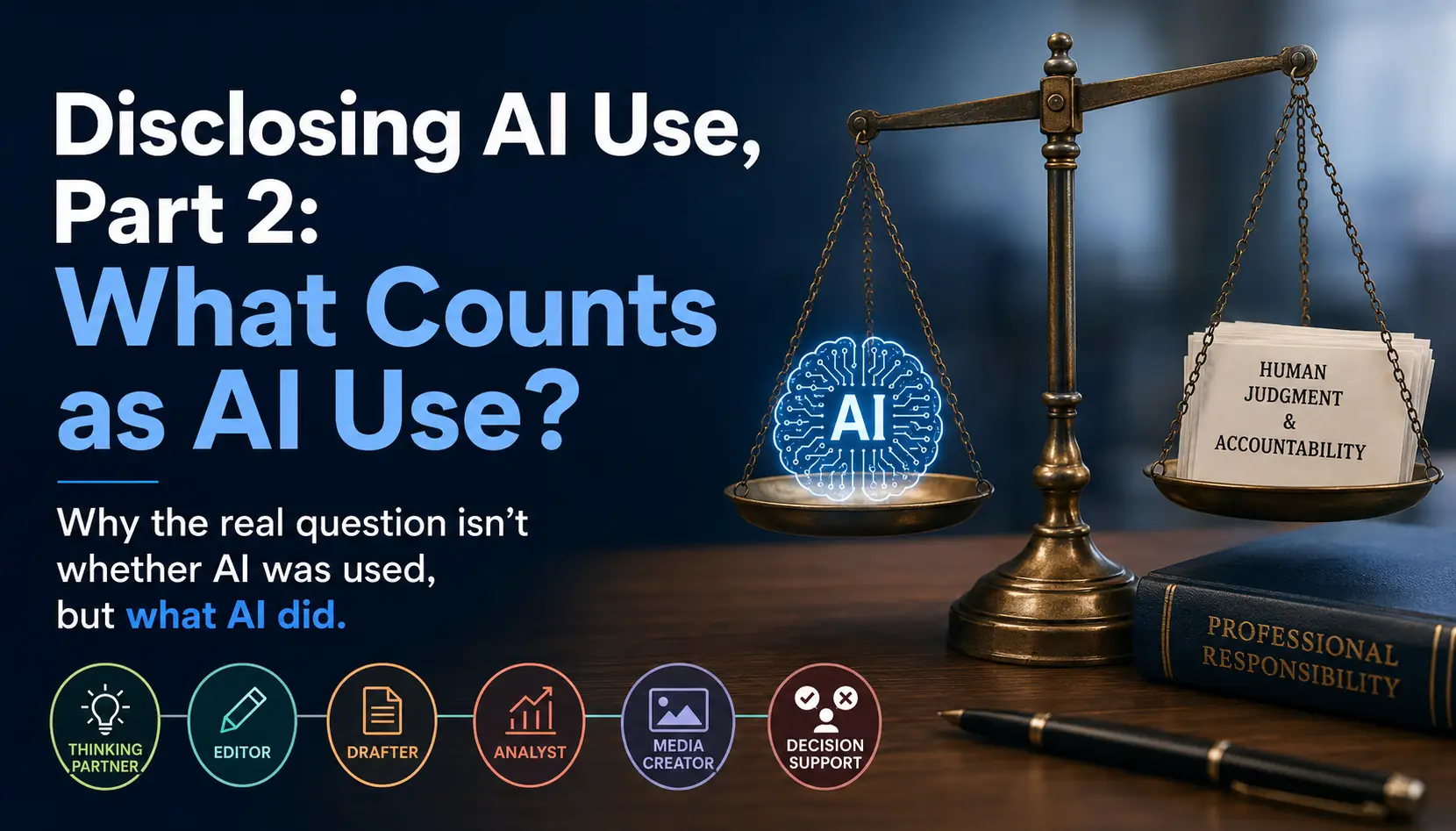
In Part 2, I focused on what counts as AI use. That post organized AI use along a spectrum, from lower-risk uses like brainstorming or editing to higher-risk uses like drafting, analysis, media creation, and decision support. That spectrum is important because not every use of AI calls for the same kind of disclosure.
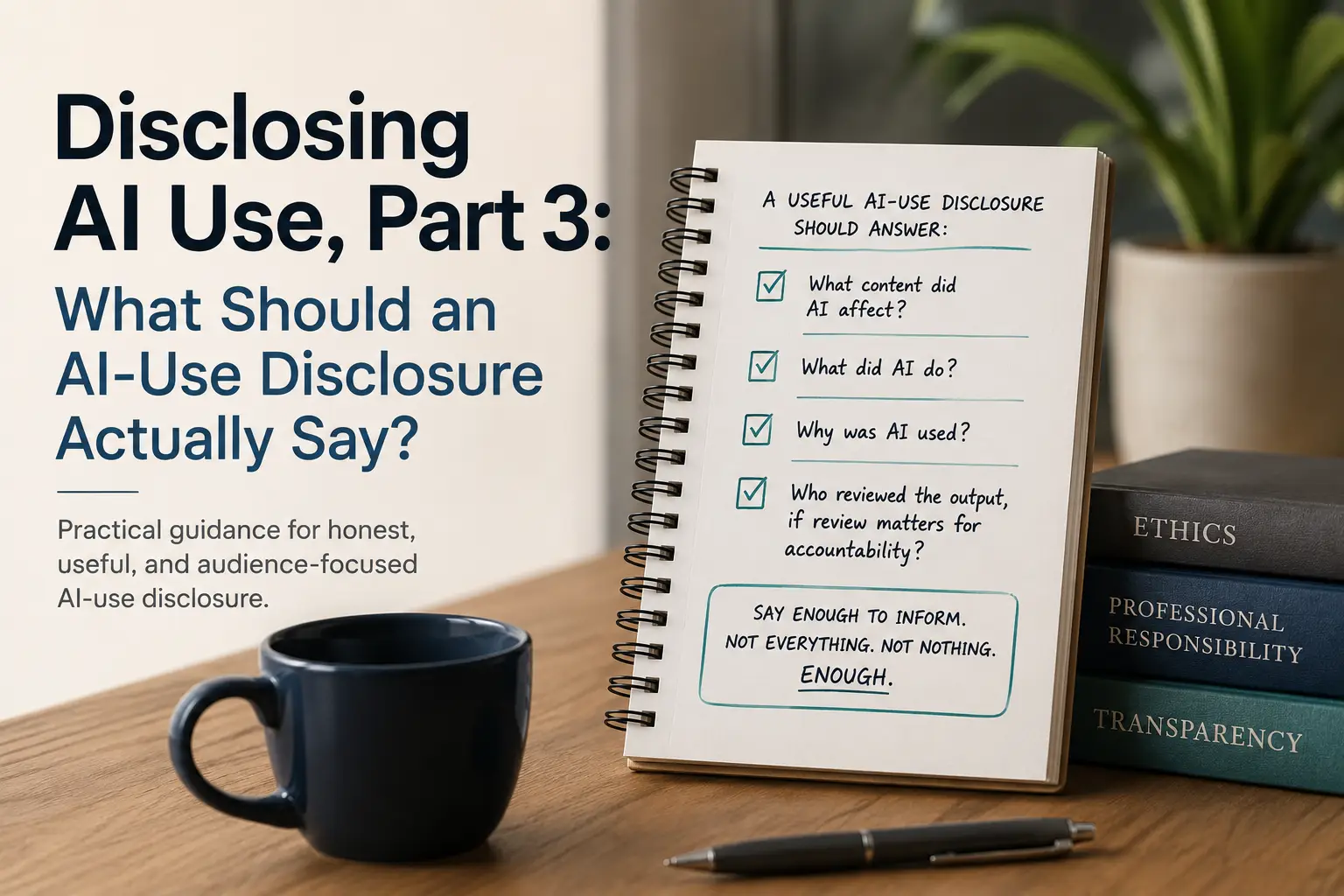
In Part 3, I turned to what an AI disclosure should say. If a disclosure is even needed, it should explain what the AI did, what the human did, and who remains responsible for the final work. The goal is not to describe every step in the process. The goal is to give readers information they can use.
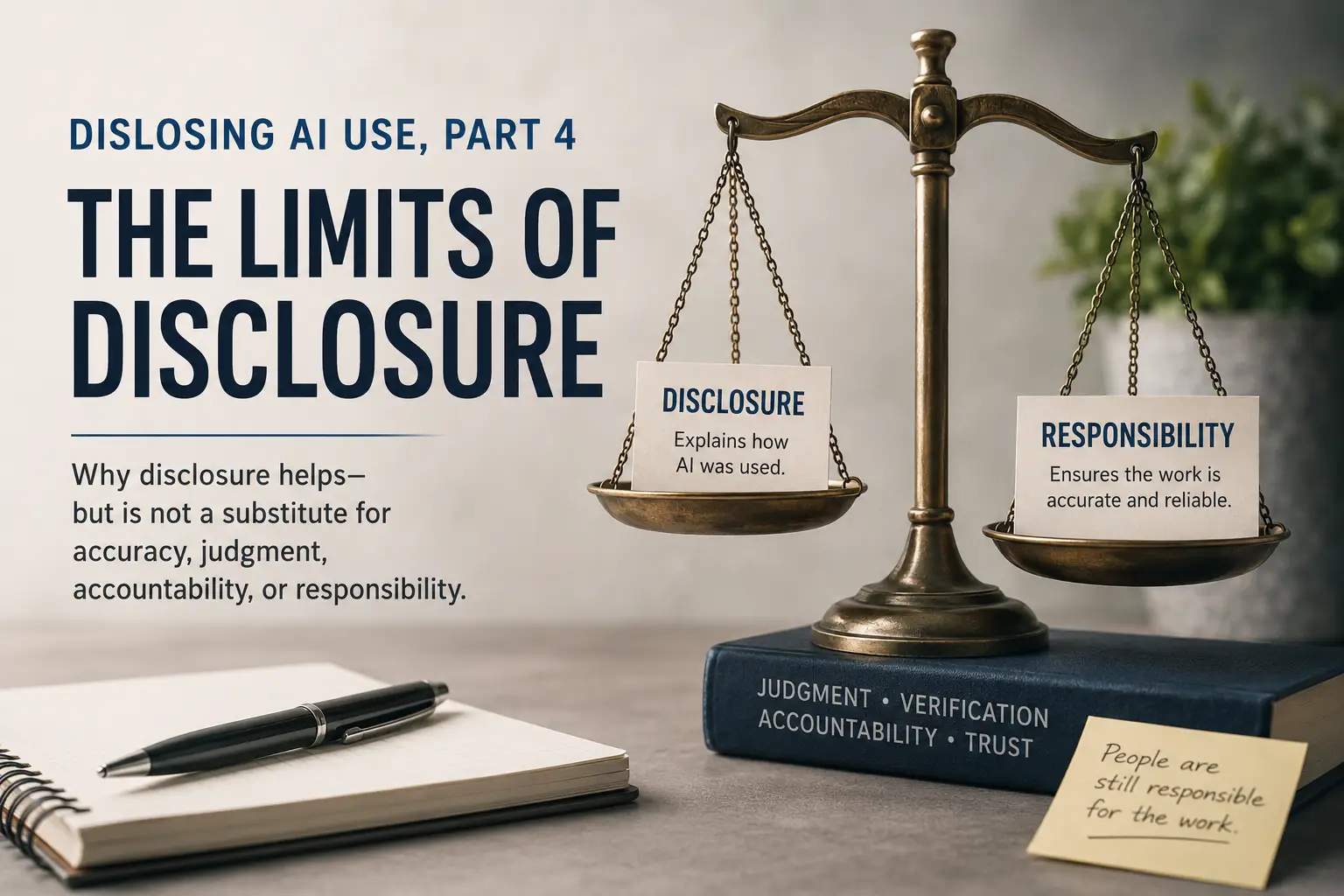
This final post builds on those points but moves in a different direction. Even when an AI disclosure is clear, specific, and useful, disclosure still has limits. It can tell people something important, but it cannot do the whole job.
Disclosure is not a substitute for verification, professional judgment, or accountability. Simply put, disclosure is not a substitute for human responsibility. Disclosure can help readers understand how AI was used. But it cannot make the use of AI responsible.
Disclosure Is Not a Substitute for Verification
A disclosure can tell readers that AI helped create something. But it cannot tell them whether the final work is correct or misleading. So accuracy requires human verification. That is especially true when using generative AI.
Generative AI can produce fluent, confident, and plausible answers that are wrong. That is part of what makes these tools useful and risky at the same time. They can help people move quickly, but they can also mask mistakes and make them harder to spot when editing.
A bad answer does not become better because the author disclosed how it was made. If an author says, “AI helped draft this article,” the reader still does not know whether the author checked the claims. If a lawyer says, “AI helped with legal research,” the court still does not know whether the lawyer read the cases. If a health communicator says, “AI helped prepare this patient handout,” the patient still does not know whether a qualified person reviewed the medical information. Disclosure can tell readers verification happened, but disclosure itself is not verification. Someone still has to do the checking.
Disclosure Is Not a Substitute for Professional Judgment
One of the main points to take away from this entire series is that professional work requires much more than accurate words on a page. It requires professional judgment. Lawyers, healthcare providers, and other professionals do not merely produce content. They decide what to ask, what risks to consider, what information to trust, and what advice someone else should rely on. AI may help with pieces of that work, but it does not replace the professional’s judgment. AI does not sign the brief. It does not treat the patient. It does not counsel the client. It does not approve the final recommendation. People do those things.
My biggest worry about the ubiquitous use of AI in professional settings is that these professionals will outsource judgment to AI and then hide behind an AI-use disclosure. A lawyer cannot file a brief with fake cases and say, “But I disclosed that AI helped.” A doctor cannot rely on AI-generated advice without exercising medical judgment. A teacher cannot use AI to evaluate student work without thinking carefully about fairness and accuracy. Disclosure may be appropriate or required in those settings. But disclosure does not replace the duty to use your well-developed professional judgement when completing the task.
Disclosure Is Not a Substitute for Accountability
Disclosure and accountability are related, but they are not the same. Disclosure gives people information, but accountability tells readers who is responsible when something goes wrong.
AI can mask responsibility. If a final product was shaped by a human, an AI system, a vendor, an institution, and a workflow nobody fully understands, the reader may not know who is accountable for the result. A disclosure can help clarify that issue, but it does not automatically create accountability.
In regulated fields, disclosure usually operates against a background of other duties. For example, the ABA’s guidance on generative AI explains that lawyers must still comply with duties involving competence, confidentiality, communication, etc. The AMA’s materials on AI in medicine likewise emphasize responsible AI use, including concerns about reliability, bias, transparency, privacy, and patient trust, as well as broader principles for ethical, equitable, responsible, and transparent AI in health care. Researchers also have duties involving authorship, citation, peer review, and research integrity, some of which were cited in Part 3 of this series. Granted, these systems are not perfect. Some are vague and enforced unevenly. But they still tell us who has to check the work, who has to protect confidential information, who has to supervise the process, and who has to stand behind the final product.
The limits of disclosure become especially important in less regulated settings. Think about wellness influencers, anonymous advice sites, AI-generated coaching, content farms, and self-help products. In those spaces, people may rely on content that looks polished, confident, and personalized. But there is usually no license, no malpractice system, no ethics board, no institutional supervision, and no clear person with a duty to verify the work.
In low-accountability settings like these, AI-use disclosure may be one of the only clues the audience receives about how the content was created. Disclosure is much more important in these settings. If AI generated advice, shaped a recommendation, simulated expertise, or created a realistic image, the audience should know that. Without disclosure, people may assume a level of human expertise, review, or accountability that does not exist.
Even then, disclosure cannot do everything. A label can tell people AI was involved. It cannot make the advice reliable or the content safe to trust. Disclosure may help people understand risk, but it does not eliminate the risk.
Disclosure Is Not a Substitute for Trust
Disclosure can support trust, but it cannot create trust by itself.
Some people may trust work less when they know AI was involved. For example, a University of Kansas study found that readers trusted news less when they knew AI was involved, even when they did not understand the extent of AI’s role. Other readers may trust AI-assisted work more because AI sounds advanced, technical, or efficient. Neither reaction tells us whether the work is accurate, fair, or responsibly produced.
That creates a communication problem. We want readers to have useful information, but we do not want the disclosure itself to become a shortcut for judgment. “AI was used” may cause some people to discount the work without understanding what AI actually did. It may cause others to assume the work is more sophisticated than it is. Either reaction can distort rather than inform.
That does not mean people should hide AI use because readers may react poorly. That would defeat the purpose of disclosure. Yet my point is that trust comes from more than disclosure. It comes from accuracy, candor, competence, care, consistency, and responsibility over time. Disclosure may be part of that, but it is not the whole thing.
Final Takeaways
If you take nothing else away from this series, remember this: Not all AI use requires disclosure, but if you do disclose AI use, make sure it helps people understand what they need to know, not simply announce that AI was involved.
That means asking a few practical questions. Did AI play a role the audience would reasonably care about? Did it affect the substance, accuracy, authenticity, or reliability of the work? Would a clear disclosure help the audience understand how to evaluate the final product?
If the answer is yes, disclose in a way that is specific enough to help. Say what the AI did, what the human did, and who remains responsible for the final work. But do not stop there. Disclosure is not the finish line. Someone still has to verify the work, exercise judgment, protect confidential information, supervise the process, and stand behind the result.
Human responsibility for the work matters more than the AI-use Disclosure.
AI-Use Disclosure: I used ChatGPT to help combine my original plans for the posts in this series into one final post. I used it to help connect this post to the first three posts, revise the structure, draft language, and sharpen the “disclosure is not a substitute” theme. I reviewed, revised, and edited the final post extensively to make sure it said what I wanted it to say and sounded like me. I also used it to create the cover photo for this blog post.