In Part 1 of this series, I argued that saying “I used AI” does not tell people enough. It sounds transparent, but it skips the part the audience actually needs to know. Did AI help brainstorm? Did it draft the words? Did it analyze facts? Did it create an image? Did a human review the final work? Without that context, the disclosure may be true and still not very useful.
That first post focused on the real crux of the problem, in my opinion: AI disclosure can become another notice people learn to ignore if we use it too often and too vaguely.
We already live in a world full of privacy notices, cookie banners, warnings, consent forms, and fine print. Some serve a real purpose. Many become background noise. If AI disclosure becomes just another automatic label, it may create the appearance of transparency without helping people understand much of anything. That is why the disclosure question should not just begin with mandates saying that “AI was used” or something similarly unhelpful. That might be a start, but by itself it is about as helpful as saying, “A tool was involved.”
So the next question is obvious: what counts as AI use?
The AI-Use Spectrum: The Problem With Treating All AI Use the Same
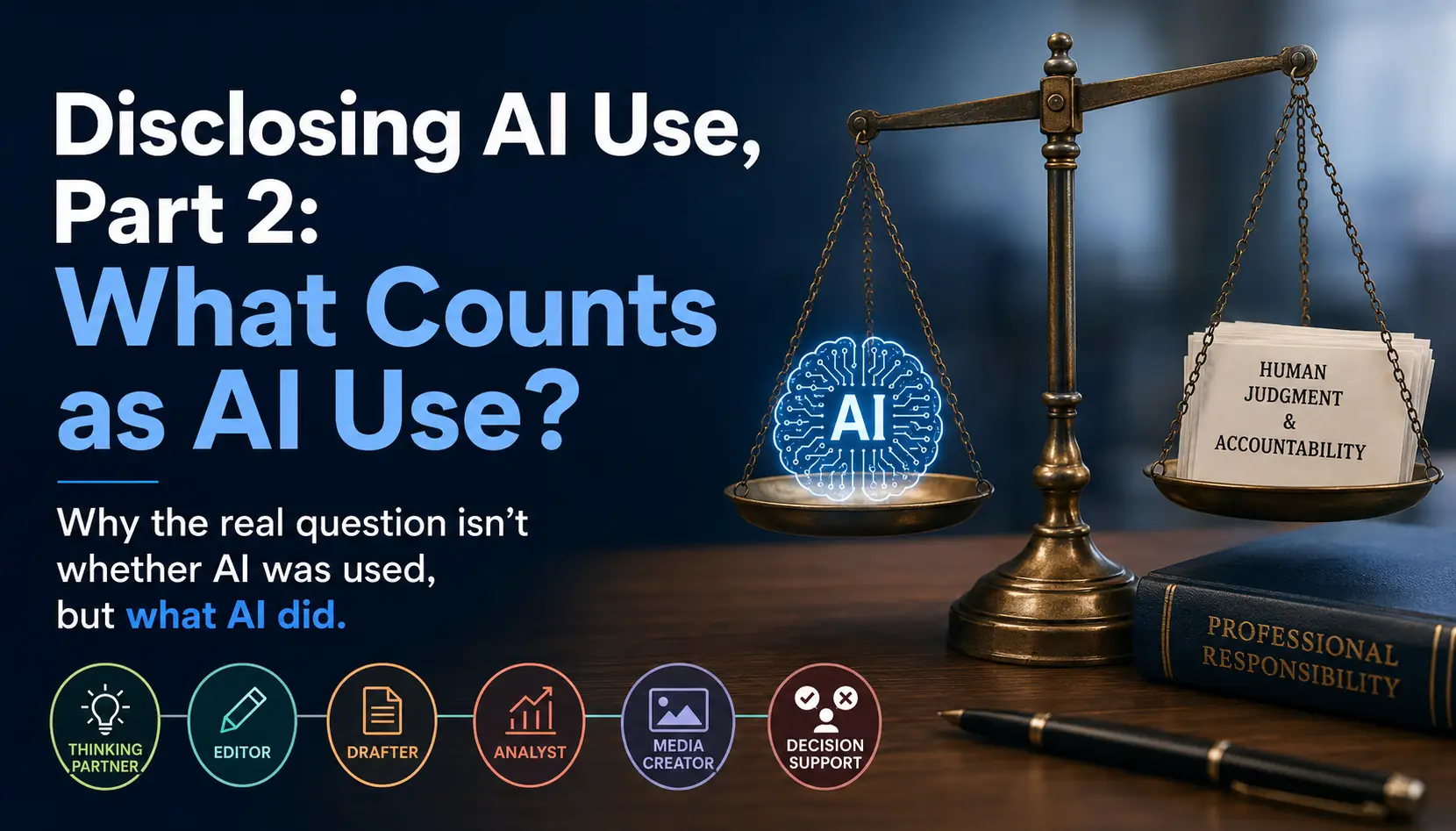
AI use is not one thing; it sits on a spectrum. That is why I believe that AI-use disclosure should center around the use involved. For example, if I use spellcheck, most people will not expect a disclosure. If Gmail suggests the end of a sentence and I accept it, no one expects a footnote. If Grammarly catches an awkward phrase, I do not think readers feel betrayed because an algorithm saved them from reading a bad sentence. We have long accepted that writers use tools. The harder question is when a tool moves from helping the writer express a thought to helping create the thought, shape the judgment, or produce something the audience will treat as authentic.
To be sure, AI tools do a lot more than catch typos. They can draft, summarize, persuade, imitate, simplify, translate, generate images, and offer analysis in a tone that sounds far more confident than it may deserve. The NIST Generative AI Profile treats generative AI as a broad risk-management issue, not as one narrow writing aid. It addresses concerns like accuracy, accountability, transparency, misuse, and human oversight. We need much more precision because AI tools that can play very different roles in the work.
1. AI as a Thinking Partner
At one end of the spectrum, AI can help us think. That might mean asking it for possible article titles, using it to brainstorm examples, asking it to identify gaps in an argument, or having it play the role of a skeptical reader. This kind of use can be valuable. It can also be annoying when the AI gives you five suggestions that sound like they came from a corporate retreat. But the point is that the human remains the source of the judgment. The AI helps provoke, organize, or challenge the thinking. It does not supply the final judgment.
I am doing some of that in this blog series. I have used AI to help organize the topic, pressure-test distinctions, and think through how disclosure could work in different settings. But I am not treating the tool as the author of the idea. I am using it more like a sounding board, except this one never asks if we can circle back after lunch.
In most ordinary public writing, I do not think this kind of use requires disclosure. If a human author uses AI to brainstorm, outline, or test ideas, and then writes, reviews, and owns the final piece, a disclosure may not add much for the reader. It may even create confusion by suggesting the AI played a larger role than it did. This is one reason a rule that treats every AI-assisted step the same will not work well. It will over disclose low-risk uses and underexplain high-risk ones.
2. AI as an Editor
A second category in the spectrum is AI editing. This includes using AI to simplify a sentence, improve readability, suggest a clearer structure, change tone, or catch awkward phrasing. This is closer to the tools many people have used for years, though generative AI can now do the job much more aggressively.
This category gets tricky because editing is not always neutral. A tool that changes tone can also change meaning. A tool that simplifies language can remove nuance. A tool that makes writing sound more polished can make the writer seem more confident than the underlying analysis supports. Still, the key question is whether AI is improving the delivery of human ideas or replacing the human’s judgment. If I write a paragraph and ask AI to make it clearer, I am still responsible for deciding whether the revision says what I mean. If I accept the suggestion without thinking, that is not an AI-disclosure problem, in my view. Plus, someone who is going to blindly accept the revision is not likely to create a very accurate AI-use disclosure either because they will just accept what AI tells them.
My point is this: in many low-risk settings, using AI as an editor probably does not require disclosure. But context can change the answer. If the writing is supposed to reflect a person’s original voice, professional judgment, or personal experience, heavy AI editing may become more relevant to the audience. A quick readability pass on a workplace memo is one thing. A heavily AI-revised personal statement, judicial opinion, client letter, or student reflection is something else. The more the audience is relying on the speaker’s judgment, care, experience, or authenticity, the more the AI’s role may matter.
3. AI as a Drafter
The disclosure question becomes harder when AI moves from helping with ideas or style to drafting the actual words. This is where I start to feel the shift in my moral compass. If I give an AI tool a few bullet points and ask it to create a patient handout, client letter, student feedback memo, blog post, or public explanation, the tool is no longer just helping me think. It is making choices about structure, emphasis, tone, transitions, and wording. It decides what sounds important and decides what to leave out.
Of course, a human can still review the draft, revise it heavily, and take responsibility for the final version. But it makes sense to be honest with the reader about what happened because AI shaped the work in a more direct way. That does not mean every AI-drafted document needs the same kind of disclosure. A first draft of an internal meeting agenda is not the same as a public-facing medical explanation or a legal advice letter. But once AI generates the words people will actually read, the case for disclosure becomes stronger, especially when the audience is relying on the communication for something important.
This is also where a simple “AI was used” label starts to break down. It does not tell the reader whether AI generated a first draft that the human rewrote from top to bottom, or whether the human skimmed the AI output and hit publish. Those are not the same: one reflects human control over an AI-assisted process, while the other may reflect human endorsement of machine-generated work. In these situations, an AI disclosure would help the audience understand that difference.
4. AI as an Analyst
The most serious category is using AI to analyze facts, reach conclusions, or support decisions. This is different from asking AI to improve a sentence. Here, the tool is doing work closer to professional judgment. It might summarize medical information, flag possible legal issues, evaluate a student’s work, compare financial options, or suggest how an organization should respond to a problem. The danger is not simply that AI might be wrong. Humans are wrong too, a fact that law professors, like me, rediscover every grading season.
The more specific danger is that AI can make weak analysis look complete. Generative AI can sound organized and correct even when it misses the point. It can produce a clean answer that hides bad assumptions. It can make uncertainty look like settled facts. It can give the human reviewer a document that feels ready for approval when it actually needs hard thinking. That is why, in my view, disclosure and professional responsibility have to travel together. A label may tell the reader that AI played a role, but it does not prove that a qualified human meaningfully checked the work.
One reason for this problem is automation bias. Researchers have long warned that people may over-rely on automated recommendations, even when they should be questioning them. A 2024 article on automation bias in public administration makes the point that human oversight is not always the safety net people assume. A person may remain formally “in the loop” while failing to meaningfully engage with the decision because the automated system has already supplied an answer. Other research on human-AI interaction in public-sector decision-making has found that people may over-rely on algorithmic advice even when warning signals point in another direction.
That is the part I worry about most. The problem is not that AI can help with analysis. The problem is when AI’s analysis becomes a substitute for human judgment rather than something humans test with their critical thinking skills. When people are busy, tired, or under pressure, a polished AI answer can become a trap. The output looks good enough to skim. The tone sounds confident and feels professional, so suddenly the human reviewer stops reviewing and starts rubber-stamping.
5. AI as Decision Support
Decision support raises even higher stakes. If AI helps decide whether someone gets a job, a loan, a benefit, a grade, medical care, or access to a service, disclosure alone is not enough. People may need an explanation, a way to challenge the decision, and a human who remains accountable. That is one of the recurring themes in this blog series. Disclosure can tell people something, yet human responsibility protects them.
We should not confuse the two because disclosure can sometimes become a substitute for professional or corporate responsibility. An organization might say, “We disclosed that AI was involved,” as if that ends the inquiry. In high-stakes settings, the real questions are harder: Was the system appropriate for the task? Was the data reliable? Did a qualified person review the output? Could the affected person challenge the result? Who is accountable if the system gets it wrong? A disclosure that does not answer those questions may be better than silence, but not by much.
6. AI as Media Creator
There are also uses that do not fit neatly into writing. AI can create images, audio, video, charts, avatars, and voices. These uses raise different disclosure concerns because they can affect authenticity. If AI creates a fictional illustration for a blog post, disclosure may be helpful but not always essential. If AI creates a realistic image of an event that never happened, disclosure becomes much more important because the audience may think they are seeing evidence of reality when they are not.
That concern is one reason the EU AI Act’s transparency provisions require certain AI systems and deployers to disclose or mark some AI-generated or manipulated content, including some synthetic media and deepfakes. The Associated Press standards on generative AI take a similar practical concern seriously by warning that AI can make altered words, photos, video, and audio appear realistic and authentic. These are worries that go to the heart of whether the audience can tell the difference between evidence, illustration, opinion, and invention.
Since I just discussed using AI to create media, here is an infographic that I put together with ChatGPT that helps pull together the disclosure categories. I do not mean these to be rigid categories. Real uses will overlap, and context definitely matters. But the basic categories are useful because the more AI shapes the substance, analysis, media, or decision itself, the stronger the case for disclosure becomes.
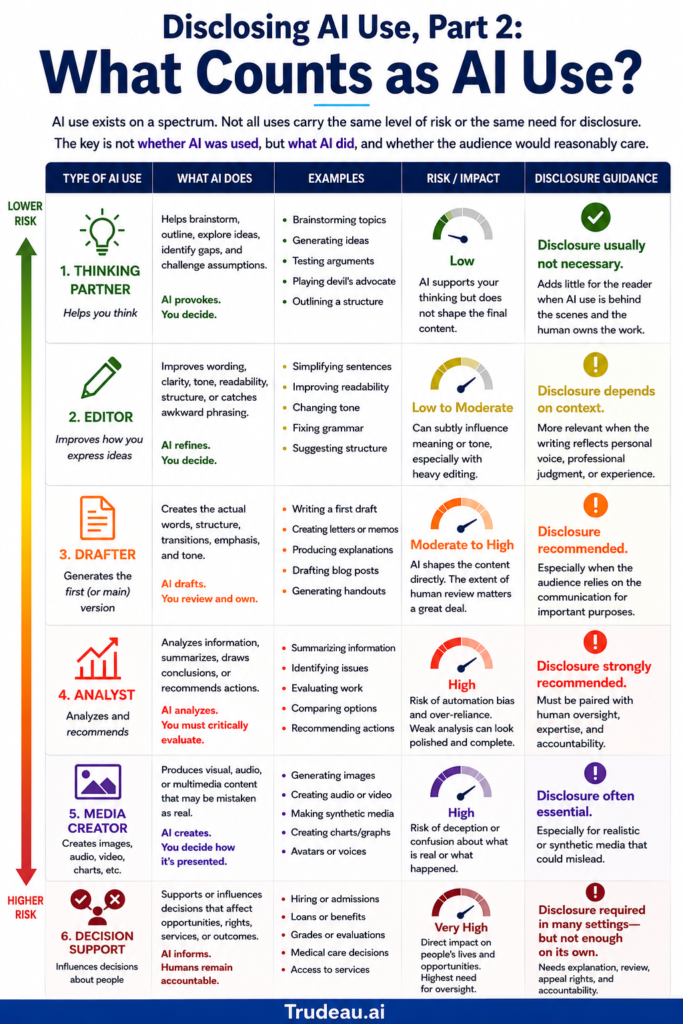
What’s the point? The Line for Disclosure Should Focus on Function
A disclosure rule based only on whether AI touched the process will sweep too broadly in some cases and not deeply enough in others. Using AI to brainstorm this post is different from letting AI write the post. Using AI to simplify a patient handout is different from letting AI generate the medical content without expert review. Using AI to create a playful image is different from creating synthetic media that could mislead people. Using AI to organize legal issues is different from relying on it to produce legal advice.
These distinctions are the difference between useful transparency and habitual labeling. If the disclosure tells the audience nothing they can use, it becomes another box-checking exercise. If it explains what AI actually did, why it mattered, and who reviewed the final work, it can help readers make a more informed judgment.
AI-Use Disclosure: I used Claude, ChatGPT, and Gemini to help me with this post. I used Claude and ChatGPT to help me brainstorm about this article and create and refine a general outline. I used Gemini (using AI search in Google) to find resources to cite for this article, which I then vetted for accuracy. I also used Gemini to create the cover photo for this post and used ChatGPT to create the infographic. I also used Claude and ChatGPT to help with some initial writing. And then I edited it extensively to make sure it said what I wanted it to say and still sounded like me. Also, I used Elementor’s AI feature to help upload the draft of the article into a blog post. If I were fully disclosing AI use, I would put the umpteen prompts I used in this disclosure, but that would make this disclosure longer than the article.